Best Dog Crates for Puppies: Sizing & Buying Guide
Find the best dog crates for puppies. Compare wire, travel, and wooden furniture crates with expert sizing charts, safety essentials, and crate setup tips.
On this page
- Why puppy crate sizing matters for potty training
- The Golden Rule of Crate Sizing
- Puppy crate size chart by weight and breed
- The top 4 types of dog crates compared
- 1. Foldable metal wire crates (Best overall for puppies)
- 2. Heavy-duty molded plastic crates (Best for nervous pups & travel)
- 3. Soft-sided fabric travel crates (Best for older, trained pups)
- 4. Wooden furniture crates (Best for home decor)
- Essential crate setup checklist
Introducing a crate into your puppy’s life is one of the kindest and most practical decisions you can make. When chosen properly, a crate is never a cage or punishment; it is a personal bedroom and safe den where your growing puppy can recharge without sensory overload.
However, walk down any pet store aisle or browse online, and the choices are overwhelming: foldable metal wire, heavy-duty molded plastic, soft fabric travel dens, and stylish wooden furniture credenzas. Choosing the wrong size or build can lead to house-training setbacks or escaped pups.
Buy for adult size, use a divider panel
Never buy a tiny crate that your puppy will outgrow in six weeks. Instead, buy a crate sized for your dog’s expected adult weight and ensure it includes an adjustable metal divider panel. You can expand the living space as your puppy grows.
Why puppy crate sizing matters for potty training
Dogs naturally avoid soiling the space where they sleep. If a crate is properly sized, your puppy will hold their bladder and whine to alert you when they need an outdoor bathroom break.
However, if a crate is too large, your puppy will sleep comfortably on one side, walk over to the opposite corner to urinate, and return to sleep untouched by the mess. This completely undermines the den instinct.
The Golden Rule of Crate Sizing
Your puppy must be able to:
- Stand upright without their head or ears touching the ceiling.
- Turn around comfortably in a complete circle.
- Lie flat on their side with paws outstretched without pressing against the bars.
Puppy crate size chart by weight and breed
Use this quick sizing chart to determine the ideal crate dimension based on your puppy’s expected adult size:
| Crate Size | Length | Expected Adult Weight | Example Breeds |
|---|---|---|---|
| Extra Small (XS) | 22“ – 24“ | Under 12 lbs | Chihuahua, Yorkshire Terrier, Pomeranian |
| Small (S) | 30“ | 13 – 25 lbs | French Bulldog, Boston Terrier, Dachshund |
| Medium (M) | 36“ | 26 – 40 lbs | Beagle, Cocker Spaniel, Miniature Schnauzer |
| Intermediate (L) | 42“ | 41 – 70 lbs | Australian Shepherd, Border Collie, Bulldog |
| Extra Large (XL) | 48“ | 71 – 90 lbs | Golden Retriever, German Shepherd, Labrador |
| Giant (XXL) | 54“ | 90+ lbs | Great Dane, Mastiff, Bernese Mountain Dog |
If you are currently teaching your dog to embrace their den, follow our detailed walkthrough on how to crate train a puppy or check our guide for older rescues on how to crate train a rescue dog.
The top 4 types of dog crates compared
1. Foldable metal wire crates (Best overall for puppies)
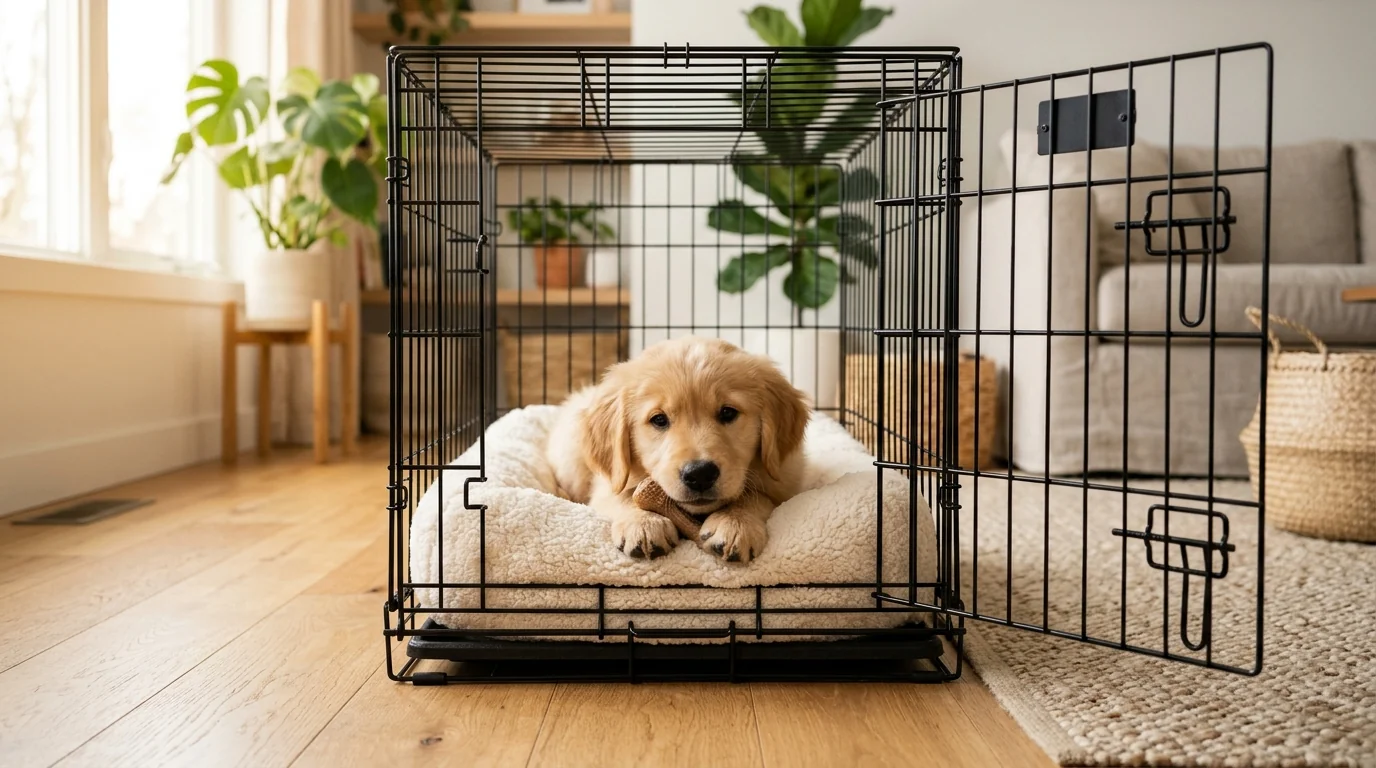
Wire crates are the undisputed gold standard for young puppies. They feature maximum 360-degree ventilation, removable leak-proof plastic bottom pans for easy cleanup, and almost always include a free divider panel.
- Pros: Inexpensive, folds flat for storage, easy to sanitize, adaptable with growth divider.
- Cons: Industrial look; noisy if your puppy rattles the bars.
2. Heavy-duty molded plastic crates (Best for nervous pups & travel)
Commonly used for airline travel, plastic crates provide enclosed, cave-like walls that help anxious or sound-sensitive puppies settle without visual overstimulation.
- Pros: Darker interior mimics a natural burrow; durable; airline compliant.
- Cons: Less airflow in warm climates; bulkier to store; usually lack divider panels.
3. Soft-sided fabric travel crates (Best for older, trained pups)
Made of nylon or canvas with mesh windows, these crates are lightweight and perfect for weekend hotel stays or camping trips.
- Pros: Extremely lightweight and whisper-quiet.
- Cons: Unsuitable for teething puppies. A determined chewer can shred the mesh zippers in five minutes. Pair with durable toys from our review of the best chew toys for teething puppies before attempting fabric crates.
4. Wooden furniture crates (Best for home decor)
Designed to double as stylish living room end tables or credenzas, furniture crates blend seamlessly into modern interiors.
- Pros: Gorgeous aesthetic that looks like high-end furniture.
- Cons: Expensive; wood absorbs urine odors if accidents happen; vulnerable to puppy chewing. Best reserved for fully housebroken adult dogs.
Essential crate setup checklist
To ensure your puppy views their crate as a sanctuary rather than confinement:
- Location: Place the crate in a semi-active family room (like the corner of a living room) rather than an isolated basement or garage.
- Bedding: Use a chew-resistant orthopedic pad or vet-bed fleece. If your puppy chews fabric, stick to a bare tray until teething settles.
- Safe enrichment: Always leave an interactive, food-stuffed rubber Kong to create positive associations.
- Covering: Drape a breathable light sheet over three sides of a wire crate to darken the interior and reduce distractions if your puppy whines. If bedtime vocalizations persist, check our troubleshooting tips for puppy crying when left alone.
Frequently asked questions
How long can a puppy stay in a crate during the day?+
A general rule of thumb is their age in months converted to hours, plus one. For example, a 3-month-old puppy can hold their bladder for a maximum of 3 to 4 hours. No dog should ever be crated continuously for longer than 6 to 8 hours without potty and exercise breaks.
Should I take my puppy's collar off in the crate?+
Yes! Always remove your puppy's collar and tags before placing them in a wire crate. Hanging tags and collar buckles can snag on wire rungs, creating an extreme strangulation hazard.
Is a wire or plastic crate better for puppy potty training?+
Wire crates are generally superior for potty training because they include adjustable divider panels that grow with your puppy, and their plastic slide-out trays make cleaning up accidental spills quick and seamless.
Where should the puppy crate be placed at night?+
During the first few weeks, placing the crate in your bedroom near your bed helps your puppy feel secure hearing your breathing and allows you to hear when they whine for midnight bathroom trips.
What if my puppy pees in their crate every night?+
Ensure the crate isn't too large (shorten it with a divider), take away water 90 minutes before bedtime, and take them outside directly before tucking them in. If accidents continue, consult your vet to rule out a urinary tract infection.
Sources & further reading
This article draws on guidance from these trusted organizations. Always consult your own veterinarian for advice specific to your pet.
Written by
Raghav DeedwaniyaFounder & Editor
Raghav Deedwaniya is the founder and editor of Petifys, and the author behind its pet care content. I’m a lifelong pet owner, not a veterinarian — I’ve been around dogs since childhood, and that hands-on experience is what got me into writing about responsible pet ownership. At Petifys I create practical, easy-to-understand guides, each one carefully researched using trusted sources such as the AVMA, ASPCA and International Cat Care. My aim is to help you make informed everyday decisions — but for anything involving your pet’s health, always consult a qualified veterinarian who can examine your animal in person.
Disclosure: Some links in this article are affiliate links. If you buy through them we may earn a small commission at no extra cost to you. We only recommend products we believe in. Learn more.