Cat Tail Language: What Your Cat Is Saying
Decode what your cat’s tail movements mean. From the question mark greeting to twitching and puffing, learn feline body language with expert tips.
On this page
- The cat tail dictionary: 8 movements decoded
- 1. High upright tail with a question-mark curve (Happy & friendly)
- 2. Low or tucked tail (Fearful, submissive, or painful)
- 3. Rapid lashing or thumping tail (Agitation or sensory overload)
- 4. Gentle twitching or swishing tail tip (Focused curiosity)
- 5. Puffed, bristled “bottle-brush” tail (Severe fright or defensive threat)
- 6. Tail wrapped around your legs or another cat (Affection & bonding)
- 7. Vibrating or quivering vertical tail (Pure excitement)
- 8. Slowly sweeping tail side-to-side (Contemplative or mild annoyance)
- Cat tail positions at a glance
Cats have a reputation for being mysterious, enigmatic creatures. But while felines may not bark or wag their tails with obvious canine enthusiasm, they communicate their emotional state clearly every single day through their tail.
A cat’s tail is a direct extension of their spine, containing roughly 18 to 23 vertebrae surrounded by complex muscles and nerves. Beyond providing balance during high-wire acrobatics, your cat’s tail acts as an emotional mood barometer. Learning how to read cat tail language will deepen your bond and help you avoid inadvertent scratches or bites.
Always assess the whole cat
Never read the tail in isolation. A twitching tail combined with relaxed ears and slow blinks means playful curiosity, while the same tail twitch with flattened “airplane” ears and dilated pupils signals impending aggression or extreme fear.
The cat tail dictionary: 8 movements decoded
1. High upright tail with a question-mark curve (Happy & friendly)
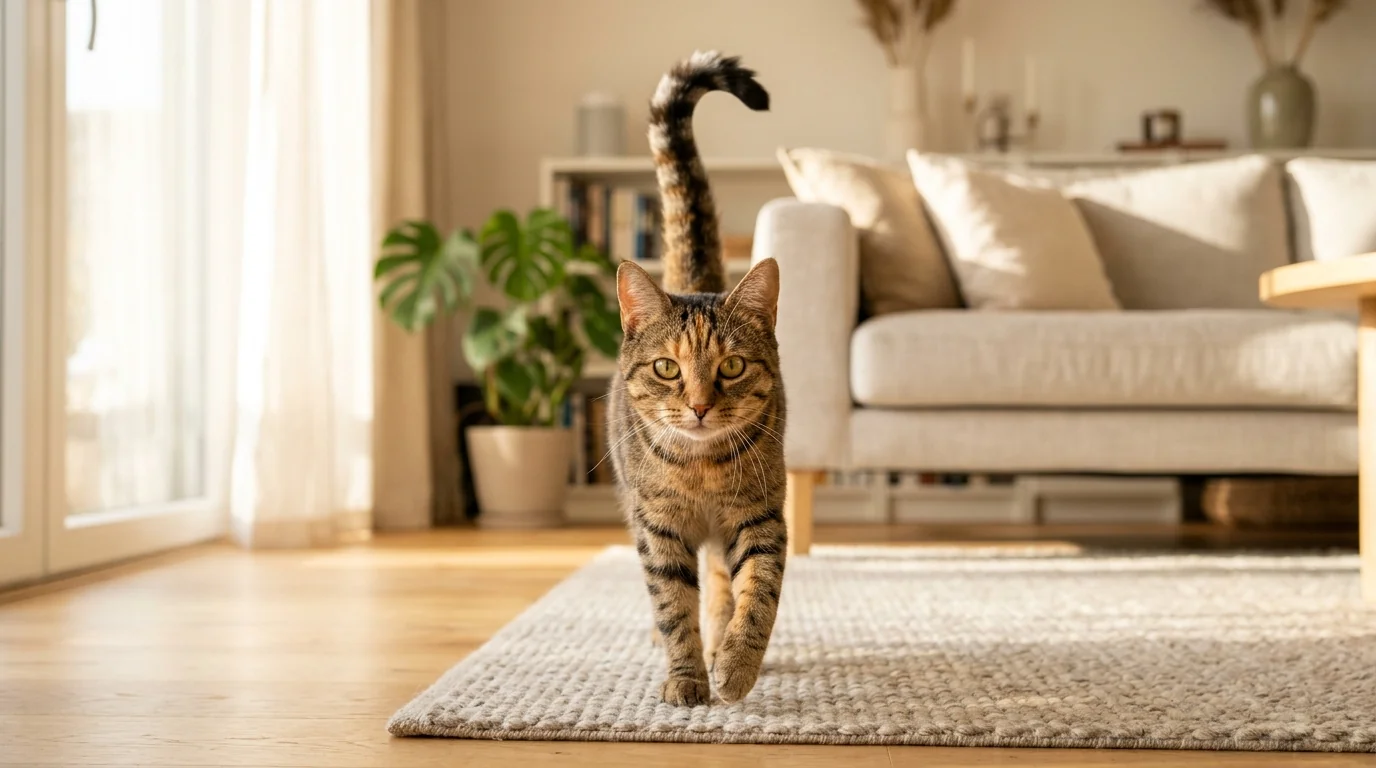
When your cat walks toward you with their tail held vertically erect and a gentle curl at the tip resembling a question mark, this is the ultimate feline greeting. It translates to: “I am confident, happy to see you, and open to gentle interaction.”
What to do: Offer your finger for a nose-touch scent greeting and stroke their chin or cheeks.
2. Low or tucked tail (Fearful, submissive, or painful)
A tail held rigidly down toward the floor or tucked tight against the belly indicates anxiety, insecurity, or submission. In multi-cat homes, a subordinate cat may hold their tail low when passing a dominant feline. If accompanied by hunching, it can also signal abdominal discomfort.
What to do: Give your cat space. Do not force handling when they feel vulnerable.
3. Rapid lashing or thumping tail (Agitation or sensory overload)
Unlike dogs, for whom a wagging tail usually indicates happiness, a cat whipping their tail back and forth with force is experiencing rising frustration, irritation, or overstimulation. If this happens while you are petting them, pet-induced overstimulation is peaking.
What to do: Stop petting immediately. Withdraw your hands and allow your cat to walk away calmly before a warning nip occurs.
4. Gentle twitching or swishing tail tip (Focused curiosity)
When the base of the tail remains still while only the last two inches flick or twitch, your cat is intensely focused on something. You will often see this when they gaze out the window at birds or stalk a feather wand toy during playtime.
What to do: Redirect their predatory focus toward safe indoor toys. Learn more about feline enrichment in our guide on are indoor cats happy.
5. Puffed, bristled “bottle-brush” tail (Severe fright or defensive threat)
When a cat feels startled or perceives an existential threat, piloerection causes the hair along the tail and spine to puff outward. By making themselves look twice their actual size, your cat hopes to deter predators.
What to do: Do not approach or attempt to pick up a puffed cat. Remove the startling trigger (such as a vacuum cleaner or unfamiliar dog) and let their adrenaline normalize.
6. Tail wrapped around your legs or another cat (Affection & bonding)
When a cat wraps their tail around your ankle or entangles tails with a feline companion, this is the feline version of a hug or handshake. Known as allorubbing, it deposits facial and tail scent markers to affirm social connection.
What to do: Acknowledge the affection with gentle praise or a favorite treat. Discover more feline bonding signals in our breakdown of why do cats knead.
7. Vibrating or quivering vertical tail (Pure excitement)
If your cat approaches you at dinner time with a tail standing straight up and quivering rapidly like an antenna, they are experiencing joyous anticipation. (Note: In unneutered cats, a vibrating tail while backing into walls is scent marking; in neutered indoor pets, it is pure excitement).
8. Slowly sweeping tail side-to-side (Contemplative or mild annoyance)
A slow, lazy pendulum wave often occurs when a cat is evaluating a situation, deciding whether to jump onto a high shelf, or mildly annoyed by background noise.
Cat tail positions at a glance
| Tail Posture | Dominant Emotion | Suggested Human Response |
|---|---|---|
| Straight up with curl | Confident, affectionate | Greet, pet, and offer love |
| Quivering vertical | High excitement, delight | Feed meal or initiate play |
| Tucked under belly | Fearful, nervous, insecure | Provide quiet hiding space |
| Puffed bottle-brush | Terrified, defensive aggression | Give space; eliminate trigger |
| Violent whipping/thumping | Irritated, overstimulated | Stop handling immediately |
| Tip twitching | Focused hunter, curious | Engage with wand toy |
Understanding these subtle physical signals prevents everyday household friction. For new cat parents, our first-time cat owner guide covers everything from litter habits to body language. If your cat pairs vocalizations with tail movements, explore our troubleshooting guide for cat meowing at night.
Frequently asked questions
Why does my cat wag their tail when I pet them?+
If the tail tip is gently swaying, your cat is engaged. But if the entire tail begins swishing or thumping hard against the floor, your cat has reached their tactile tolerance threshold and is politely asking you to stop touching them.
Can a cat communicate without a tail (like a Manx)?+
Yes. Breeds with naturally bobbed tails or cats that underwent medical amputation rely more heavily on ear orientation, whisker position, vocalizations, and pupil dilation to express their feelings.
Why does my cat wrap their tail around their paws while sitting?+
Tucking the tail neatly around their front paws while sitting upright signifies calm self-containment, polite detachment, or an effort to conserve body heat in a cooler room.
What does it mean when a cat's tail is bent or hooked downward?+
A downward hook often signals defensiveness or cautious hesitation. The cat is alert to their surroundings and ready to leap into action if an unexpected threat emerges.
Can a cat break or sprain their tail?+
Yes. Tail pull injuries or getting a tail caught in a closing door can dislocate vertebrae and damage nerves that control urination and defecation. Seek immediate veterinary care if the tail hangs limp or appears painful.
Sources & further reading
This article draws on guidance from these trusted organizations. Always consult your own veterinarian for advice specific to your pet.
Written by
Raghav DeedwaniyaFounder & Editor
Raghav Deedwaniya is the founder and editor of Petifys, and the author behind its pet care content. I’m a lifelong pet owner, not a veterinarian — I’ve been around dogs since childhood, and that hands-on experience is what got me into writing about responsible pet ownership. At Petifys I create practical, easy-to-understand guides, each one carefully researched using trusted sources such as the AVMA, ASPCA and International Cat Care. My aim is to help you make informed everyday decisions — but for anything involving your pet’s health, always consult a qualified veterinarian who can examine your animal in person.
Disclosure: Some links in this article are affiliate links. If you buy through them we may earn a small commission at no extra cost to you. We only recommend products we believe in. Learn more.